Saturday, 11 September 2021

The Much Needed Reform in Agricultural; Model Agriculture Land Leasing Act 2016

Niti Aayog in 2016 designed a model act in order to secure the rights of tenants and ownership of landlords. However in many states revenue laws provide for right to ownership by proving adverse possession for a certain period as prescribed by the actual tiller. But the census 2011 reveals that the extent of lease in the country is around 6 per cent. In the absence of a legal provision back-stopping such leasing, most of it is oral and therefore does not entitle the lessee to claim the status of a farmer and access various benefits available from the government and credit institutions. 

Hence in 2016 NITI Aayog offered an appropriate template for the states and UTs to draft their own piece of legislations, in consonance with the local requirements and adopt an enabling Act that focused to secure the interests of both the land owner and lessee ‘Bataidar’ .

The model Act permits and facilitates leasing of agricultural land, to improve agricultural efficiency and equity for owners at the same time it also provides access and legal status to landless and semi – landless poor tenants. A proper implementation of this act with due deliberation would have enable a lessee to have a legal status that enables them to get
1) Access loans through credit institutions
2) Benefits of insurance schemes
3) Financial aid by state for disaster relief and crop failure
4) Loan Waiver benefits
5) And many other support services provided by State Government
The Government of MP has passed the bill formulated by NITI Aayog however it lacks the proper provision to ensure the proposed benefits by original model act. Hence the act of MP government certainly requires some amendments to address the local challenges and issues to make the act efficient.
Proposed recommendations are as follows.
1) Issuance of Credit Eligibility Certificate or Loan Eligibility Card for tenet
2) Enforce the lease agreement between Land Owner and Tenant to eliminate the condition of oral agreements
3) Provision of mention the name and account number of tenant for crop Insurance
4) A fast track tribunal to resolve the complaints of tenants in case of denial of rights by Owner
5) Provision to distribute the financial assistance by Central or State Govt like PM Kisan Samman Nidhi

The toothless bill is depriving millions of farmers Madhya Pradesh of benefits of government farm-support schemes Fasal Bima Yojna, Bhawantar Bhugtan Yojna, Pradhan Mantri Kisan Samman Nidhi to land less cultivators.

Monday, 16 August 2021

A scheme to revamp or a ruse for sway; Union Ministry of Cooperation

Let your thoughts and decisions be based on thinking of all your colleagues so that such decisions are followed by one and all . Unity should prevail. Let your intentions be common. Let your hearts’ desires be similar. The spirit of togetherness must prevail in your lives.
Rig Veda १०/१९१/३-४ 


These shloka from Rig Veda represent the Vedic notion of mutual growth and combined prosperity by conjoint effort. India has been a promoter of the idea to rise above individuality for mutual good since ages. However the modern cooperative business was introduced here in the colonial era for the safeguard of farmers and artisans whose profit got a lethal hit due to the industrial revolution and rampant capitalism. Cooperation of people or the integration of public resources is being considered a silver bullet by the Modi government to re-track the economy, severely hit by pandemic and its eventuated multiple restrictions on businesses. This was the reason that on the occasion of 75th Independence day PM Modi included the importance of cooperatives in his address to the nation. However, the government showing concern about the cooperatives is the biggest irony in India as government control over cooperatives have been the biggest threat to independence of the movement. Co-operatives were introduced as a formula in which a group of financially unsound people through integration of their resources tries to gain advantage over powerful enterprises. Many previous governments had provisions to harvest the immense possibilities of cooperatives to revamp the rural economy. But going a step forward, the Modi government has created a new central Ministry to superintend and foster the cooperative movement in the country. 
It remains to be seen whether this newly created Ministry will actually work in the direction of restoring the fundamental order of cooperatives in India or if it is another astute move by Home Minister Amit Shah to consolidate BJP’s hold over rural politics. Of course the Sharad Pawar way to hold the power at grassroots level by dislodging and weakening other political parties’ power structure at regional level. Amid the political milieu of the country where almost every political party has lost the faith and grip over rural economy and rural politics. The state cooperatives will be an important beachhead to defend their sway in rural vote bank among rising discontent of farmers. 
As per the Media reports the new Ministry will regulate the functions of multi-state and state level cooperatives. But isn’t a paradox that a new body is created to control or “oversee” the functioning of the bodies which are already suffering the overdose of political involvement.  What actually cooperatives need is the conducive environment to re-install the cooperative value in the members who possibly confuse it for a subsidy collection window. Member's ownership and independence from any political influence is the core cooperative principle. And retaining this should be the primary agenda of any government that sincerely looking for solution of rural financial distress in cooperatives movement.

Monday, 19 October 2020

'The Great Tale of Hinduism' book by Author Prathviraj Singh


The Great Tale of Hinduism is an inspiring, colourful and engaging story that brings Hindu culture and spirituality alive in a unique way for the modern reader to carefully examine and appreciate. 
In this book authors have covered in a short space an extensive ground of Hindu teachings. IT provides a panoramic view of a Hindu approach to religion, philosophy, science politics, mythology, art, the role of women and the past and the future of humanity. The book brings Hinduism alive as a continual development of wonder and creativity that renews itself in every generation, honoring the Divine in every name, form, facet and manifestation. 

Foreword of this book is written by Vedacharya Padma Bhushan Shree David Frawley.
(https://en.wikipedia.org/wiki/David_Frawley)

Namaste (Introduction).
Muriel Rukeyser, an American poetess and writer said “the universe is made up of stories, not of atoms”. Muriel specifically talks about human society. Which is woven on the skeleton of stories, folklores and popular tales about their genesis and reason of existence. Every society’s attitude, their moral and general behaviour is derived from the stories they believe in. Hence this book ‘The Great Tale of Hinduism’ developed on the premise of popular “tales” of Hinduism which distinguish classic Indian society from others. 


All nine chapters of this book deal with different ideas which are the basis of core Indian philosophy. To exemplify these involved ideas, we have taken support of classic tales of ‘Hindu History’. Tales about the human traits of gods and godly traits of some humans. Popular stories which show that not even gods are always correct and even they will not be spared of the law of karma when they are wrong. Classic example of Vishnu is used to corroborate this point where Vishnu in his Krishna avatar shot from behind of a tree by Jara hunter (Bali of his previous birth) for the same act he had done in Ram avatar with Bali. Here are tales which show how a mere mortal by his courage and determination can outgrow his human desires and attain a position reserved for gods. 

A Tryst with Hinduism
This chapter revolves around the core Hindu idea that reality doesn’t lie on extremes. All truths are subjective hence always lies in the centre or in grey areas. This book rejects the demarcation of truth and false on the basis of white and black. Because every white is a brighter shade of grey and every black is a darker shade of grey. As the most gruesome villain of ‘Hindu history’ Ravana is praised for some of his good deeds and even Ram, the most favourite Hindu god is questioned by authoritative religious texts for some of his decisions. Which demonstrates that no one is absolutely good or bad. Every character is an interplay of Triguna and the most dominating guna defines a character in terms of good or bad.
The Real Nature of Myths
The second chapter talks about the significance of religious texts and their stories which has been side-lined by calling them mythology. But these are the tales along which our society and our basic character is intertwined. Keeping our progeny aloof of what actually they are made up of is a big injustice to them. These religious texts actually tell us how our society has evolved through various changes and what made Hindu religion survive through this long stream of time. 

The Vedic Harappan
The third chapter “The Vedic Harappan” tries to fill the gap between antedated Vedic-kal and ancient history. There are myriads of written work of great scholars which try to fix Vedic origin way before the Indus Valley Civilization and not as it is explained through Aryan Invasion Theory. But there is dire need to corroborate the Vedic behaviour of Indus Valley people, in case they were part of continued Vedic Culture. Hence with the support of scholarly work done in the past we tried to prove our point and its significance for present society.
 
The Beginning of Game of Thrones
Fourth chapter “Beginning of Game of Thrones” is an extension of the previous chapter which bridges the gap between primitive Vedic society and the history of present India. Here we describe the inception point of Human society and its evolution along with frequent changes taking place in its nascent stage. The explanation also includes the role of Vedas in moulding the Hindu society and the corruption came with time into the core teaching and how we dealt with it. Sometimes we fail, sometimes we succeed but we never succumbed to it. 
The Era of Empowered Women
Chapter number five is dedicated to the other half of human society, the half neglected from centuries. A rational analysis of the reason for the present condition of women, which is based on the scientific theories of human evolution and Social Dominance Theory. How much Vedas and other religious text are responsible for the social discrimination of woman is also discussed here. Some tales and references from Vedas are given to assert the point that Vedas endorse equality among all living creatures and confer equal position to women but it was counter forced by the inertia of patriarchal ascendancy.
When The Ancient Wonders of Bharatvarsha were Carved
Chapter six talks about the great structural acumen of early Indian society. Examples of structures like Ajanta and Ellora caves are given, which took faith of generations and efforts of centuries to take its present form. These structures are evidence of the power of spiritually immersed human brains, when it strives to transcend its human limitations, when it thinks beyond survival. 

The Pioneer of Vig-Gyana
Authors have tried to claim seeds of many scientific discoveries that can be attributed to Indians. Yes, it would be imprudent to claim the material manifestation of every great discovery on some Indian name. But at the same time we have to give credit to Indian minds who thought and wrote these ideas thousands of years ago. When half of the world was busy in securing their living. Some convincing arguments and valid references are produced to make our readers believe in the author's point and to not look lopsided while advocating the rich scientific heritage of India.

Fortune Favours the Brave 
Eighth chapter starts with a mention of Alexander and the story of the Gordian knot of his life and then shifts to discuss Indian style of administration. Various Indian Emperors Ashoka vs Janaka and Chandragupta vs Dasharatha and their style of administration with the commonalities in them on different aspects. In this chapter, the reader will learn how rich ancient India was politically and about the different experiments India’s democracy has evolved through.

Conclusion
Ninth chapter has the conclusion of every idea discussed extensively in this book. A reference tale from ‘Yog-Vashishth Maharamayan’ is taken to describe the real nature of Hindu Dharma. Here every being is allowed to be elevated to the status of divine and even Gods are relegated to lower status. Misunderstanding between religion and culture is held responsible for tension in the present society and therefore an explanation of both is also given here for better differentiation.

Hinduism is the most talked about word of recent time but unfortunately Hindus are the people who are either not adequately informed or mis-informed about their culture. Authors do not claim this book to be a guide book for Hinduism but this book will definitely raise interest of people to know more about Hinduism from the classic and authentic sources. 

Friday, 16 October 2020

बॉलीवुड का धर्मयुद्ध या मीडिया की सनसनी?


आज सुशांत सिंह राजपूत मामले के 4 महीने पूरे होने पर अगर हम ठगा सा महसूस नहीं कर रहे तो मान लीजिए कि देश का मानस सही दिशा में नहीं है। हर संभव मुश्किल से जूझते वक़्त जिस शालीनता के साथ हम ने मीडिया और बॉलीवुड के बीच मचे छीछा लेदर का लुफ्त उठाया है वह या तो कोई बुद्ध समाज कर सकता है या कोई बुद्धु समाज।

भाई भतीजावाद के झंडा बरदार घोषित हो चुके बॉलीवुड के 18-20 के लड़के लड़कियां जो कि भारतीय न्याय तंत्र के हिसाब से अभी कुछ महीने पहले ही समझदार हुए है, उन्हें हाशिए पर चड़ता देखने की उत्सुकता मे अंधे हो चुके लोगो ने जब इस के शांत होने के बाद वास्तविकता से आंख मिलाई होगी तो एक बार मन ग्लानि से जरूर भर गया होगा। कई सवाल है जो मेरे चारों तरफ से भी सुनाई से रहे है। उनमें से एक बड़ा सवाल यह है कि क्या मीडिया का रवैया सही था? जिस में सबसे पहले फैसला सुनाया, फिर अपराधी ढूंढे और उस के बाद खुद ही जांच बिठाई जिस में शुक्र है कि थोड़ी बहुत मदद सी.बी.आई की भी ली। और फिर ऐसा माहौल बनाया कि मानो इस धर्मयुद्ध के जीतते है देश की सारी परेशानियां खत्म हो जाएंगी। और समाज फिर एक बार स्वर्णिम युग में प्रवेश करेगा। ये तो भला ही हुआ कि प्राइम टाइम पर किसी को लाइव फांसी नहीं हुई। मीडिया की वक्र दृष्टि से बच बच कर कई बिद्धिजिवियो ने यह सवाल भी उठाया कि क्या पूरे देश का बमुश्किल 500-600 लोगो से बने बॉलीवुड में इतना रुचि लेना सही है। जब की करोड़ों  बेरोजगार और आर्थिक तंगी से पीड़ित लोग किसी को अपना दुखड़ा सुना तक नहीं पा रहे। और अगर हम यह मान भी लें कि ये 500-600 लोग देश के लिए इतने अहम है तब भी क्या उनके अंतरंग जीवन में किसी का कैमरा ले कर घुस जाना सही है? 


मेरे लिए इन सवालों का जवाब मिला इस है इंडस्ट्री के सबसे प्रमुख निर्माता द्वारा चलाए जा रहे एक टीवी शो में। चाय पर चर्चा का अंग्रेजी रूपांतर यह शो जिस में वह सभी बॉलीवुड सितारों से पूछते है कि आप अगर सुबह किसी और के बेडरूम में जागती या जागते है तो आप क्या करेंगे? या फिर इन सभी सितारों में से किस से आप सिर्फ वन नाइट स्टैंड वाला रिश्ता रखेंगी, किस से आप प्रेम प्रसंग चलना चाहेंगी/चाहेंगे और किस से शादी करेंगे? इस ही शो के माध्यम से हमें यह बताया गया कि किसी के जीवन की अंतरंग बातो मै कितना मजा लिया जा सकता है। किसी फिल्मी कलाकर के वैवाहिक जीवन के बाहर चल रहे प्रेम प्रसंग आम जनता को कितनी खुशी देते है। और सब से ज्यादा मजे कि बात की इन सितारों को भी ऐसे बर्ताव या सवालों से कोई अपात्ती नहीं होती। खुद ही को चरित्रहीन और बेपरवाह होने का सर्टफिकेट देते वक़्त इन फिल्मी सितारों को अंदाजा भी नहीं होगा कि जो बबूल आज वो बो रहे है इस के कांटे इन्हें कितनी जोर से चुभेंगे। जिस ड्रग पार्टी का वीडियो खुद ही शेयर कर ये इतरा रहे थे वहीं वीडियो इन के गले की हड्डी बनेगा, इस बात का अंदाजा भी इन बेचारों को नहीं होगा। यह पूरा घटनाक्रम हमे भी सीख देता है कि आज के इस युग में आप मर्यादा भंग तो बड़ी आसानी से कर सकते है पर फिर बाद में इस कि कोई सीमा या दिशा तय करना किसी के भी आपे से बाहर की बात है। 


खेर इन्हें फिल्मी सितारे कहा भी इसीलिए जाता है क्यो की फिल्मी कि ही तरह इन की चमक भी बनावटी होती है। और इस में कुछ ग़लत भी नहीं। आखिर किसी अच्छे कलाकर से यह अपेक्षा रखना की उस की राजनीतिक, सामाजिक, न्यायिक सूझ बुझ भी उतनी ही अच्छी हो जितनी अपनी कला में है, यह तो उस के साथ भी ज्यायती होगी। इसी ही लिए मैंने खुद को उस फूहड़ टीवी शो के होस्ट कि जगह रख कर देखा और विश्वास मानिए उस कि परेशानी का एहसास भी मुझे हुआ। किसी भी साक्षत्कार की जान होता है उस में बुलाया गया मेहनाम जो वास्तविक दुनिया और जीवन के अनुभवो से ओत प्रोत हो। जिस के सीधी सदी बाते और किस्से भी लोगो को लुभाती हो। किसी भी क्षेत्र में अपनी मेहनत से नाम कमा चुके लोग जब कुछ बोलते है तो वह अपने आप ही दर्शक को सुहाना लगता है, प्रेरणा देता है। आप अगर एक सफ़र तय किए व्यक्ति जैसे अमिताभ बच्चन, शाहरुख खान, जावेद अख्तर या देवानंद को सुनेगे तो मुझे नहीं लगता कि उस में अश्लील और फूहड़ बातो का तड़का लगाने की आवश्यकता किसी को भी महसूस होगी। पर जब इंटरव्यू किसी ऐसे सितारे का हो जिस की चमक भी मां या बाप की उधर दी हुई हो या जिस का सबसे बड़ा टैलेंट जबान से अपनी नाक छू लेना हो तो कार्यक्रम को मनोरंजक बनाने के लिए ओछी बातो का सहारा तो लेना ही पड़ेगा। पर अब आखिरी में यह समझ नहीं आ रहा कि देश के 5 महीने बर्बाद करने का इल्जाम किस के माथे डाले। पहले ही खुद को थल में परोस कर प्रस्तुत कर चुके बॉलीवुड पर या उस थाल में दावत उड़ा चुकी मीडिया पर या फिर खुद पर जो इन सब बातो में ड्रग्स के नशे कि तरह पड कर अपनी सुद बुध भुला बैठे है।


लेखक:- प्रथ्वी राज सिंह

Sunday, 23 August 2020

Harvest of Hope

When the fear of Covid19 still has a tight grip over the entire world a new fear of collapsing economies is ready to strangle the neck, especially of the developing nations. Any proper assessment of the actual effects of this pandemic on the global economy is yet to come. But one thing is sure that it has hit-hard already-slowing Indian economy. Financial experts say that this crisis will leave a permanent scar on India's growth story. According to Mumbai based credit rating agency CRISIL a huge contract will be in GDP numbers for 2020-21 and to catch-up a surge of 11%  would be required for the next three fiscals; which is quite unprecedented and less likely to happen in the case of India.

Among the many negative impacts of the greatest lockdown happened in India in the end of March 2020 the biggest ones are the erosion in job-base and consumer spending. The household spending which has been shifted to subsistence (survival) level during lockdown will remain cautious and timid under threat of a second wave of virus followed by another lockdown. Indian consumers will likely to save their resources for survival for the case of any recurrence.

For a country like India where major parts of demand and investment both come from domestic spendings and savings respectively. A revival in consumption is much needed, as Biocon chairperson Kiran Mazumdar Shaw  said, "Demand is going to play a very big part in economic revival, and if we cannot kick-start demand I fear then we cannot have economic revival.”

To rebound the economy a lot of emphasis is being paid for revival of the manufacturing and service sector by liquidity infusion and easy credit access. But the question rises that unless there is a revival of demand who will they sell their goods to? In this toughest time can Agriculture emerge as a saviour?  

Indian Agriculture sector which still accommodates more than 50% of the population and largest labour force of 145 million is also the least hit sector during worldwide spread of Covid 19. Many farm produce counted as essential goods the agriculture sector had exemptions to sell their produce even in the complete lockdown. 

Due to PM Kisan Sammam Nidhi and KCC loan, farmers reported that there has been a negligible impact on household consumption during lockdown. At the same time rabi production of 2020 especially wheat yields was record high. The Civil Supplies Corporation and Marketing Federation of Madhya Pradesh procured 128 lakh tonnes of wheat against 84.89 lakh tonnes yields of last year. The total wheat procurement in the country has touched 386 lakh tonnes as against 368 lakh tonnes of last year. In the process of rewarding the higher yields of farmers of Madhya Pradesh, the State government has infused  liquidity of 21 lakh crores into the market through 14.22 lakh bank accounts of farmers. This fiscal stimulus straight into hands of farmer/farm-labourer has become the fuel to restart the growth story of the country, which had been on halt for 3 months. Negligible tax burden and increased income has raised the purchasing power of farmers which is very necessary for industrial growth. As agriculture supplies the raw material to various agro-based and FMCG companies. A good harvest plays a vital role in both internal and external trade of India. 

Moreover, the forecast of higher production of kharif crops due to good monsoon this year has filled farmers with positive sentiments. And even the top economists believe that demand in a huge and developing economy like India is mostly sentiment driven. Euphoria of good harvest can be the required impetus for positive consumer behaviour. Hence Agriculture can definitely be the silver lining in this darkest hour of Indian economy.

We living in the manufacturing and service driven economy sometimes undermines the facts that India is the largest producer of milk, pulses, and jute, and ranks as the second-largest producer of rice, wheat, sugarcane, groundnut, vegetables, fruit, and cotton. Additionally being the second largest producer India is also the largest exporter of rice and wheat, it can also fulfill the demands of the countries which are dependent on imports for their food security. Decreasing rates of crude oil and increased export of agriculture produce can definitely subsidize  the trade deficit of our country. Especially in the time where many major exporters have withdrawn from the international market to avoid the exposure of Coronavirus.  In this crucial time any small stimulus given to the agriculture sector by the government can re-track the entire economy. The recent forecast by CRISIL shows agriculture will still depict an impressive growth of 5.9% in Q4 of FY20, when GDP may register negative growth.

All the aforementioned facts show that when all the other businesses grapple with losses, the reopening of the economy poses fresh challenges for tackling the second wave of Covid-19. Agriculture is the only bright spot or the harvest of hope for India. 


Thursday, 30 May 2019

Expectation of Indian Economy from Modi 2.0

2019’s general election was special in many ways, after almost 50 years any government came back to power with such majority. In the parliamentarian democracy people voted on the pattern of presidential form of Government. Once again we have proved that in India, election and good economy has no connection. Although rural distress, unemployment, lack of infrastructure, slow growth have always been the talk of the town before and after the election. But in the elections voting outcomes always be different then it is perceived, on the basis of the economic success of previous Government. Narshingma Rao and Atal Bihari are two best examples. People of India voted out the Government who was responsible for historic 1991’s economic reforms. Similarly people also voted out Late Atal Bihari’s Government which has many credits of economic success on its name.


Perhaps this is the reason both the Government and opposition parties kept all economic worries aside. People also forgot rising rate of unemployment, muted earnings, undercapitalized NBFC’s with poor credit disbursement and covering up of real issues with dubious statistics. The country has suffered after effect of demonetization and teething effect of GST for almost  2 years but all these issues could not become the hot topics of discussion of election campaign. India voted on emotional, religious and security related issues, yet we all know the importanc of a good economic health for any country like India. Modi’s come-back reverberated with his old slogan of 2104 “sabka saath, sabka vikas” which can be translated as ‘inclusion of all, in economic progress’.


In case of India many times macroeconomic indicators do not reflect the ground reality for every state or some region or a group of people. Therefore rather than discussing the key fundamental of macroeconomics which hardly relates to a common man, we are discussing easily relatable micros. All a common man wants is a good job or a profitable business, proper infrastructure, cheap credits and safe investment avenues. No matter what the GDP numbers are saying he just want to feel secure about his own business and not about fiscal deficit of the country.

So in corollary the expectations from this Modi Government is also very basic. To provide with good earning opportunities in jobs or in business Government should start from they left, but this time with more thrust. Some extra attention is required to improve the business climate of India so it can attract investors who are looking for new avenues amidst of US, China trade war. Although India had improved a lot in ‘ease of doing business’ in Modi’s last term, India jumped to 77th rank from 131. But internal shocks of demonetization, complex GST and high interest rate averse the investors. This economic upheaval also slowed internal demand and sluggish growth which turns into job-loss and investment aversion from inside of the country. We must not belittle domestic investment as 80% of investment comes from domestic investors. As the dust of demonetization has settled now a simplified GST in pipeline and a moderate interest rate regime will do some help in coming years. Although frequent change in tax structure generally create disruption in market and its adaptation takes time. Eventually this time Government has to be extra cautious about simplification. Hopefully the new Direct Tax Code also add some more euphoria to the market and raise demand if good exemptions given under it.

A good banking system is like engine of growth for a country. Moving ahead with idea of recapitalization of banks and privatization of loss making and non strategic public sector bank can proved to be a great stimulus to economy. Easy and cheap credits can compensate the loss of growing unemployment in the country. Being it PM Modi’s own idea for which he also brought Mudra Loan scheme, he may put special emphasis on the idea this time.

Major reforms in agriculture sector is expected by all analyst as doubling farm income is priority on Modi’s agenda. Hopefully this Government will be more focused on agri-business by providing better access to technology, awareness of schemes and good Infrastructure to increase shelf life of produce. A restructuring in APMC act is also expected to make direct market more functional in agriculture. On-spot value addition to the agricultural produce can be a revolutionary idea for Indian farm business. It can empower farmer more than any other subsidy can do. There is also a urgent need of increasing per hectare productivity because increasing MSP is not a permanent solution. So cheap procurement of better seeds and better irrigation facility should be the top priority of Government.

One thing that is commonly accepted by all Indian after seeing Modi’s five year in centre that he is capable of doing what he determines to, Swachh Bharat is a live example. Although this Government will not have too much room in fiscal deficit for increasing public expenditure but there is lot of space for disinvestment in non-strategic PSUs. Modi may face some fiscal constraints but he has a good intent and also lot of support both from inside and outside of parliament. Conclusively Modi’s 2nd term can be historic for India’s progress.

Tuesday, 20 June 2017

WAVES OF loan WAIVER

Cascading effect of farm loan waiver is considered one of the most hazardous appeasement in present economic scenario.
This year after the huge victory, Yogi's UP govt waied off 36000cr farm loan. Maharashtra is lining up for 35000 cr waiver apart from that Devendra fandavis is also planing to give 10000 rs for every farmer has 5 acer or less land holding which will cost around 6000 cr rupees. Madhya Pradesh govt is intend to follow the same trend. 
Center is planning to give interest subsidy worth 20000cr.
All of these adds up to 97000 cr rupees.
If this trends continues and all states waive farm loans it will be around 2.75 lakh crore rupees 2% of India GDP.


The World Bank reports says 'Loan waiver scheme had no effect on productivity, wages or consumption. It led to an increase in default among borrowers that were previously in good standing.'
ICRIER says 'Generalized debt relief, discourages prompt repayment with expectation of more such waiver'.


But for the matter of fact no such voice is being heard about corporate loan waiver no group of intellectuals or economists shown concerns over the corporate loan waiver issue
Total write offs of corporate loan bet 2012 to 2016 is 2.25 lakh crore according to RBI in TOI approximately equal to farm loan waiver for 4 years. Estimated future corporate debt write off as per the report of India Rating Report 2016 is rupees 4 lakh cr debt by 85 companies.


Total corporate loans is 28  lakh crore rupees viz a viz total farm loan is 12.6 Lakh crore but percentage of stressed farm loan is 17% which is around 2 lakh cr rupees relative to stressed corporate loan which is also a close fig of 18% around 5 lakh cr rupees. But their is always a brouhaha about the deficit cause by farm lan waiver. Are the farmers in any which way some less productive businessman of the country? Or the agriculture is something this country doesn't care about and can be replaced easily? If not, then why economists worldwide raise eyebrows on any such decision?

Monday, 12 June 2017

खेती.....यज्ञ या व्यापर?

जिस प्रकार पूर्व काल में ऋषि-मुनि अपनी भौतिक सुख सुविधाएं त्याग कर शहर से दूर और प्रकृति के निकट रह कर अपनी प्रिय वस्तुओ का हवन करते थे ताकि दूसरी प्रजा सुखी रहे, वर्षा अच्छी हो परिणाम स्वरुप फसल अच्छी हो, राज्य संपन्न हो, प्राकृतिक आपदाएं टले। कई यग्यो में कर्ता के प्राणों की भी आहुति देने की बात पढ़ने को मिलती है। क्या हम किसान आत्महत्या का महिमामंडन करने के लिए उसे इस ही तरह की आहुति मान सकते है? तब तो हमे किसान को भी ऋषि मानना पड़ेगा पौराणिक काल में ऋषियों का जो आदर था वो भी किसानों को देना पड़ेगा। कई उदाहरण है शास्त्रो में जो बताते है कि समय-समय पर राजा नंगे पांव ऋषियो के दर्शन करने जाते थे जिसका एक प्रयोजन यह भी होता था कि उन् की सारी जरूरतो का ध्यान रखा जाये और अगर कोई कमी है तो बिना मांगे उपलब्ध करवाई जाए ताकि समाज के अन्नदाता को किसी के सामने हाथ ना फ़ैलाने पड़े। पर अब परिस्थिति परिणत है। परंतु अब परस्पर हाथ फ़ैलाने का रिश्ता है   शासक और कृषक के बीच, पांच साल में एक बार शासक इनके सामने और बाकि  पांच साल किसान, शासक के सामने।


पर अगर खेती व्यापार है तो दृष्टिकोण बदल जायेगा। फिर तो किसान को एक असफल व्यापारी माना जायेगा जो की खुद तो पूरे देश को खिलाता है पर खुद कुपोषित है, जो खुद तो देश की अर्थ व्यवस्था मूल है पर खुद की आर्थिक स्थिति दयनीय है, जिसके घर अच्छी पैदावार का लाभ पूरा देश उठाता है  सिवाए खुद के। कमी कंहा है, गलती में कौन है सरकार या किसान। अगर किसानों के हितों की रक्षा सरकार का उत्तरदायित्व है तो ये याद दिलाने के लिए आजादी के 70 सालो बाद किसानों को उग्र आंदोलन करने के जरूरत क्यों पड रही है क्या पिछले 7 दशकों से हम एक विफल राज्य में रह रहे है जिसमें सरकारे अपनी 60 फिसदी आबादी को दो वक़्त की रोटी और मूलभूत सुविधाऐ भी मुहैया नहीं करवा पाई।

यदि इस मुक्त बाजार प्रणाली में किसानों को अपने हित खुद सुरक्षित रखना है तो क्यों सरकार जब फल, सब्जी या खाद्यान महंगे होने लगते है तो कुछ वर्ग विशेष के तुष्टिकरण के लिए निर्यात कर दाम कम रखने में लग जाती है।  क्या सरकारी हस्तक्षेप सिर्फ शहरी गरीब और मध्यमवर्ग को लाभ पहुँचाने के लिए है।

साल दर साल किसानों की जोत छोटी और कर्ज बड़ा होता जा रहा है। छोटी जोत में ज्यादा पैदावार देने वाली फसले जैसे की प्याज, टमाटर,आलू एकदम से प्रचलित होते जा रही है और परिणाम स्वरुप इनके भाव कम से भी कम। बुद्धिजीवियों द्वारा इस कुचक्र से निकलने का एक मात्र उपाय सुझाया गया है कि जमीनी तौर पर मूल्य संवर्धन इकाईया लगायी जाये जिससे किसान खुद अपने उत्पाद को प्रसंस्करण कर उचित लाभ कमा सके और साथ ही साथ मौसमी बेरोजगारी से भी निजाद पा सके।

अब सरकार को ये निश्चित करना है कि खेती को व्यापार मान कर किसानों को अपना मुनाफा कमाने में स्वसामर्थ करना है या यज्ञ मान किसानों को अपने प्राणो की आहुति देने के लिए छोड़ देना है?

Thursday, 27 April 2017

Will Kulbhushan be Next Sarabjit?

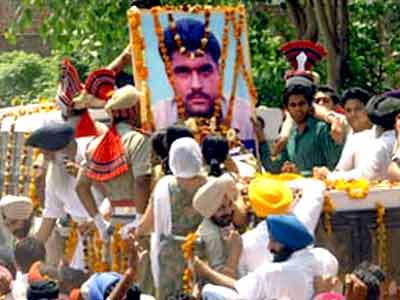
Kulbhushan Jadav an indian citizen who took premature retirement from navy and doing his business in Iran, was abducted and taken to Pakistan and their tried by military court which awarded him the death sentence. Indian Government reacted with rightful indignation and warn Pakistan for dire consequences.
Similarly Sarabjit Singh who was also an Indian national, convicted of terrorism and spying by a Pakistani court. Was tried to bring back home by the UPA government but failed, despite a high decibel campaign for his release.
While in prison at Kot Lakhpat Jail, Lahore on this very day in April 2013, he was attacked by fellow inmates and died six days later on 2nd may, at the Jinnah Hospital, Lahore. We also could never bring back our 53 POW of Bangladesh Liberation war of 1971. So India has very bad track record of bringing back it's people from foreign soil.


Where Pakistan has declared Kulbhusan their enemy number one on international platforms and awarded the capital punishment to boast this as a strategic achievement will it be possible for India to get it done through diplomatic devices with the pseudo democratic and insidious state of Pakistan, certainly doubtful. But our government's stand of going out of its way to save kulbhushan is being correlated with strong personality of our present P.M. and the government with full majority. So now whole event is a litmus test of Mr. Modi's strong personality and diplomacy will it work now? After spending so much energy and resources on his foreign tours to get a strong hold on world politics, will it bring some fruit now? It is remains to be seen that how this suspense of "out of the way" will end.


On the death anniversary of Sarabjit we need to interospect the progress of India under Modi government relative to India of 2013 and before, did we gain some more relative political capacity, globally? Did we realize our potential as a strong country with not to be mess around to our neighbors like China and Pakistan? Or we just participating in fray of becoming a self proclaimed superpower or vishwaguru in our words? 

Saturday, 1 April 2017

State Of Agriculture

There is lots of brouhaha of Farm loan waiver for marginal and small farmers in Uttar Pardesh. This decision could open a Pandora's box as it can fuel similar demands from many other states but it is government's call to take a prudent decision over this issue. Though there is a consensus among politicians, economists and thinkers of society that until we address these issues of farmers properly there will be no substantial growth in the country. All developed economies were agrarian before they were industrialized, only their period vary. Once democratic system developed, the first thing developed economies of today did was to complete agrarian reforms in time-bound way.  As Land remains the means of livelihood for large section of society in an agrarian economy the successful completion of agrarian reforms benefited the maximum number of people thereby improving their economic condition.

So it is very clear now that development of agriculture and farmers is the foremost prerequisite for development of country but are we sussing out their issue completely and correctly. Because data of land records says that 140 million hectare of land is used as agriculture land and this area is distributed among 138 million farmers. In 2011 there was 93 millions were marginal farmers (holdings of less than one hectare). Since smaller land holdings are either fragmented of large holdings which have been passed on within the family or have been informally leased by a large holder, farmers who cultivate these holdings often do not have a formal lease agreement. Sans of any land records tenant is not eligible for formal credit or other government benefits such as input subsidy or crop insurance schemes and if majority of most needy people are excluded from government's welfare schemes and policies then how it would be "sab ka saath, sab a vikas".


Access to agricultural credit is linked to the holding of land titles. Consequently these tenant farmers who account for more than 28% unable to access institutionalized credits for purchasing inputs,seeds, weeding, harvesting and transporting. As a results these farmers primarily borrow from informal source of credit such as money lenders, shopkeepers, relatives and friends on much higher interest rate. As per the report of the Committee on Medium-term Path on Financial Inclusion,RBI more 60% credit of marginal and small farmers comes from informal source of credit. To overcome this NITI Aayog has  proposed a model land leasing law to provide for the litigation of land leasing. This would ensure that land owners have the security of ownership rights, and land tenets are secure in their tenancy.  Legalization of land tenancy would also ensure that farmers get access to formal credit, insurance and input such as fertilizers but this Model Land Leasing law has been adopted only by Madhya Pradesh Government so far. As agriculture is a state subject it is all up to state governments to implement  this original Model law or to bring it with some modifications or to not pay attention to this issue at all but one thing is very evident that agriculture in this country has to go through some serious changes. Because it will never be viable for any marginal farmer with small land holding to follow conventional farming practices and sustain in farming business. So it s remains to be seen that how India will cope up with this deteriorating issue. Can this country ever move towards Cooperative farming like USSR (erstwhile) or will opt for Corporate farming like America and Canada? While in India land is considered a symbol of social prestige, status and identity unlike other the countries which succeeded in their land reforms programmes where it is seen as just an economic asset for income-earning.

Sunday, 12 March 2017

Indianization/Rationalization of Financial Year

In a row of Modi government's radical reform process a most expected reform to come next is change of financial year from 1st of April to 1st of January. Modi government has taken many bold moves like scrapping of Planning Commission and demonetization and merger of Rail Budget with Common Budget so there is a huge probability that Modi Government will  come up with this kind of revolutionary change when this idea has backing of many elite assemblies of economist, administrator and social thinkers.
Chamberlain Commission (1913),Sir Dinshaw Wacha Commission (1921) under British Government, 1st Administrative Reform Commission (1966), LK Jha Commitee (1984), C.Rangarajan  (2011, Planning Commission) all have favored the idea of changing India Financial Year.


In west countries 25 march is celebrated as Lady Day, on this day angle Gabriel informed Virgin Mary that she would be the mother of Jesus Christ. This date is also close to equinox  so it marked as the division of the fiscal year therefore in west 1st of April was celebrated as new year for psychological and cultural reasons. From 1867 British Raj made first of April new financial year to align India's budgeting system with their budgeting system in England. Indian constitution's article 112 says president will lay annual financial statment before Parliament every financial year but there is no clause which define financial year rather article 370 (1) says to refer general clause act 1897 for interpretation of financial year. Means that can require a constitutional amendment. Where not having majority in Rajya Sabha could be a hurdle in that process.


Recently Modi government had set up a high level commitee headed by Shankar Acharya (former Chief Economic Advisor) to examine feasibility of shifting financial year to January 1st. The committee has submitted its final report to Finance Minister. It has given various merits and demerits of change of financial year and its effect on the different agricultural crop period and its impact on business, taxation system and procedure, statics and data collection. Change of financial year will help to align tax collection and Budget Estimate with actual receipt and expenditure. It will also help to account for impact of monsoon and other socio economic aspects of India for better planning and resource allocation especially for transforming ruler India.


In present budget making process we use last year's monsoon data which is nearly 8 month old so it doesn't give correct projection of next year's tax collection and expenditures. Generally all Multi National Companies maintain their annual reports from 1st January but in India they have to maintain another records from 1st April also in alignment with government financial year so this change would be considered as one more step towards ease of doing business in India. Bibek Debroy member of NITI Aayog has aslo favored following the calender year as financial year. It remains to be seen that with how much conviction Modi Government go on implementation of this idea but one thing is very clear that Modi ji has done every thing to look different than previous Government which was infamous for not taking decision. So if you think that your business will be affected by this change (if it takes place) get yourself ready for next Modi move.

Thursday, 14 July 2016

SUCCESS OF STORIES

Once I heard Muriel Rukeyser's (an American poet) quote "The universe made of stories not atomes". That time I was too busy to understand the logic of these magical words but when I understood how could i resist myself of sharing it?

Every mind, every new second, making a new story, making a new world or universe in their mind. These stories sometime influence your mood, your action, performance, and ultimately your life. Only stories of those who dominated the scene of THE world or of THEIR world are remembered and we know them as LEADERS. This breed carries some fascinating characteristics like.....
1. A leader is one who takes the initiative, never wait for someone's support.
2. He/she never afraid of taking responsibility, never backstep himself, by looking probability of failure or defeat.
3. Intuitive knowledge of when to strike and till when to wait for right opportunity, makes good leader.
4. He should has a ear to the ground so he/she can hear voice of footsteps of what coming next. Ultimately leader can sense the danger and should be able to avert it.
5. A good instinctive leader never traped by advise of experts or surveys in other words he/she doesn't completely bank upon those advises.
6. A leader always keep a eye on internal working of his/her institution and try to maintain coherence among all.
7. He/she always find solutions to keep people happy.
8. Always take up challenges never avoid challenges.


Above all, according to me, A LEADER is one, who can see a unforeseen dream, believe on it and make it happen. He should also have charm to make people belive on the idea what they are striving for. In other words he should win confidence of people around him.

Remember this world will give you everything, if you are just good in your work but arrogance of doing it with excellence just because you are involved in it will make you GREAT.
So try to be great, try to live a great life because any thing less than this will be an injustice to the species you belong to. The most EVOLVED one, the most COMFORTABLE one.

Monday, 21 March 2016

THE TOLERANT CIVILIZATION OF INDIA


INDIA, the country of great civilization, great culture and diversity which it earned by assimilating new religion, faith and ideas open heartedly. Weather it came from within the society like JAINISM, BUDDHISM or SIKHISM or from any other part of the world like CHRISTIANITY, ISLAM, ZOROASTRIAN, JUDAISM and many more. Because the core belief of this land says that the supreme power, the god gifted us these religions and cultures for our spiritual nourishment, our well being and moral prosperity not for what is happening these days, mankind is servering religion by trying to spreading it till last corner of the earth. This practice seems like " rider being ridden by horse". I think that is why we do not have any supremely authoritative text. On this land God did not declared any final truth, i think god had some hope from this land of seekers that they will find it by their own. Actually this desire of seeking of the truth gives us a meaningful spiritual life but in case you are handed truth in the very first chapter of your life then it is very evident that you waste rest of your life in convincing or sometime compelling others to believe on your subjective truth but this land never did this injustice to its progeny. That's why we have more than 100 interpretation of our Ramayana, Mahabharat and Gita. Because we respect everybody's truth. After all respecting and adorning the truth, the God lies in every heart is more important than any scripture or holy text.


We have some oldest Christian of earth in Kerala, the second mosque of the world after Madina erected in Gujrat by permission of a hindu king, this is the only country which never persecute Jews, we have micro minority Zoroastrian living here with dignity. The core philosophy of this civilization is so liberal that it never resist any new idea, philosophy or scientific discovery contrary to that we lived in harmony with these. Unlike west where geniuses like Galileo, Socrates, Archimedes had to die or persecuted, we revered our scientists and innovators calling them Rishi or Maharishi like rishi kanak, rishi Bodhyayan, rishi sewetketu and rishi Charvak who's philosophy is not coherent with any Indian philosophy.


We have witnessed brutal conquest, persecution and confrontation but yet retain our cultural roots. We may have lost battle of sword but we resisted intellectually for more than thousand year but nowadays this great believe system is moribund not because of any external aggregation but because of deficiency of confidence in our own culture. We have our reference point of social values in west, our every greatness of past should be certified by them first then only we recognize it.


In Syria every school going kid learn stories of great Indian traders of 4000 year ago, in Lebanon everybody reads about 4300 year old temple made by Indian traders, with the help of Indian labourers of stone brought form India and having a lotus on its ceiling. Does any Indian child know about Angkor wat in combodia made by khmer king suryavarman 1000 years ago which is the largest temple of earth.
Our education system is legging in telling tell us about our glorious past so it is unable to build pride about who we were and who we are. Then how come this progeny will make a pride Nation

Tuesday, 26 January 2016

MAHARISHI BHIMRAO AMBEDKAR

Maharishi Bhimrao Ambedkar. Its a wierd way to commemorate Ambedkar as a maharishi. A presone who defied veda's authority all his life after learning that veda's are prejudice for shudra. Who is shudra and who is Brhaman has been debated from long, whether this terms meant to defined by cast or by born of a person. Similarly who is maharishi is also debatable in modern times, who should be called Maharishi , is it a gender agnostic term or only male scholars could be Maharishi ? would only a person comes from a particular caste or clan can have claim over this title ?
Let's try to find out answer in our scriptures and mythology.


Many ancient sages and rishis came from humble backgrounds. Vishwamitra was a warrior by birth but practiced austerities like a Brahmins and became a great rishi. Sage Parashar, the famous law giver, was the son of an outcaste (chandala). Rishi Vashista was born to a prostitute ,while sage Vyasa, the original author of the Mahabharata, was born to a fisherwoman. Rishi Valmiki the original composer of Ramayana came from a tribal family of traditional hunters. Some composers of the Vedic and Upanishadic hymns belonged to either lower castes or mixed castes. Satyakam Jabala was born to a prostitute who could not tell him who was his father.


                             Manu himslef said Brahmin is an incarnation of dharma born to protect dharma as ambedkar saheb did throughout his life. But in present time his name is remembered as a person who bring RESERVATION in Constitution. That is why backward classes revered him as a prophet while been out of reach of reverence of forward classes. Remembering B.r. Ambedkar just as a giver of reservation or a leader of a particular class would be a huge unjustice to the society. When one look at Dr. Ambedkar's life,masseges and achievement he was a lot more than this.


Ambedkar was a prolific student, earned a law degree and various doctorates from Columbia University and the London School of Economics, and gained a reputation as a scholar for his research in law, economics and political science. In his early career he was an economist, professor, and lawyer and later emerged as a law giver, philosopher and a social reformer who rekindled Buddhism in indian society. He was also a strong believer in democracy by his intellect he played a major role in making of Constitution, a Democratic form of government through which he tried to establish a Democratic form of SOCIETY.

                If we honestly juxtapose his contribution with our former reformers and  maharishies like Aryabhaat, charak,valmiki it was not lesser to anybody,so in my opinion he evidently deserves this title and respect of Maharishi in our society.

As purush sukta of RIG VED  says shudra bron out of bhramas feet and feet of god usually most worshipped part of body.
So for us its time to follow vedas commandments and adopt Ambedkar saheb as latest MAHARISHI of hindu society

Friday, 4 December 2015

AVTAR 1.0 (DASHAVTAR)

In 1859 Charles Darwin came up with theory of evolution. Darwin published his theory of evolution with compelling evidence in his 1859 book On the Origin of Species, overcoming scientific rejection of earlier concepts of transmutation of species. By the 1870s, the scientific community and much of the general public had accepted evolution as a fact. But still it was not allowed to teach anything which goes against biblical stories untill Clarence Darrow in 1930 established this in famous scopes vs state or scopes monkey trail. The trial publicized the Fundamentalist–Modernist Controversy, which set Modernists, who said evolution was not inconsistent with religion, againstFundamentalists, who said the word of God as revealed in the Bible took priority over all human knowledge. The case was thus seen as both a theological contest and a trial on whether modern science regarding the creation–evolution controversy should be taught in schools. Sanatan scripture,sanatan puranas(vedic stories) has a subtle evidence of Darwin's theory. Dasavtar of vishnu quit resembles with this theory. This is not something like new discovery but widely known and accepted. Sir John Woodroffe (1865-1936), Advocate General of Bengal and Legal member of the erstwhile Govt. of India, had the same conclusion after the study of vedic texts. He said and I quote,
"Ages before Lamarck and Darwin, it was held in India that man has passed through 84 lakhs births as plants, animals, inferior species and then came the ancestors of developed man existing today. The theory was an act of brilliant deduction in which observation may also have had played part!"
Many articles and explanations have given of this resemblance so I will not go in much detail but just for better understanding lets take a succinct veiw


Matsya -the fish, a aquatic life form engendered in water to  save Manu from the super catastrophe 
Kurma- the amphibian life form the supporter of the world Varah- the boar, the terrestrial or mammal incarnation 
Narsimha- half man - half loin, beast tends to be a man by wining over a demon hiranyaksyapu
Vamana- the dwarf man or pygmoid followed by
Parashuram- fully developed jungle dweller wielding primitive arm Axe
Ram- A civilized man with more sophisticated arms like bow and arrow and highly developed social structure and relationship institution. Age where homo sapiens and proto humans (vanaras) both exist
Krishna- purna avtar the complete human being who not only following social and moral codes but also break them when it needs.
Buddha- the enlightened one, the wiser man, who not only thinks about mundane luxury or comfort but beyond human human existence, the spiritual side.
Kalki- the destroyer, intended to come in kaliyug.


But in these kinds of versions we miss the important half of our society WOMEN , so lets trace presence in this version of human history.
It first appeared in Vaman avtar as mother Aditi who's husband abandoned her after the birth of last son who is Vaman himself , which suggest that institution of marriage was not well structured and well defined. As Scriptures says rishi svetketu codified this institution of marriage but it doesn't means before this institution women were subservient to men in any which way, either they were equal as both had right to end up the relationship or women were superior as they had right to choose their partner. Which last till long in form of Swayanvar.
Next avtar Parashuram a mertinet a strict rule follower, was son of jamdagni and renuka. Where father had abjured mundane life but still living his hermit life with his wife and children. Which means commitment of husband wife's relationship was stronger than before.
In Ram avtar importance had given to almost every relationship which we are celebrating today whether it is brother -sister, mother-father, inlaws or friendship. Ultimately this newly developed human society was at peak of purity of social and moral values even this avtar fought against breach of this codes with Tadka, Surpnakha, Bali, Ravan. Everyone of them were guilty of breaching these highly respected moral values like Bali kept tara his younger brother's with him after denying Sugriv of his share of property. Ravan also guilty of stealing Ram's wife. Tadka was notorious asura who disturbes rishis in yagya and their free movement in jungle. Surpnakha, being a woman tried to seize other woman's right. So that is why this avtar called maryada purushottam "The ideal man"

Next one is not ideal but he is purna avtar "the complete man" KRISHNA avtar. This avtar does not only respect social ethos and moral but also break them when it needs. This suggests that the relationships meant to be respected are not sacrosanct, even they could be corrupted. When devar (brother in law) behave not like Laxman but like Duryodhan, he is worthy to penalize. When Jesth pita (uncle or grandfather) discriminates between his children and children of his younger brother and deprived them of their rights, its ok to be disobedient towards him. All highly respected elders like pitamah, gurus or elder brothers should vacant their legal position in royal court if they allows breaching of fundamental principals (mul dharma of shastra) to protect rules (niyam made by interpreting shastra) in their presence.
Krishna also introduced two other relationships between man and woman. Which are of sheer friendship and sheer love.
Two most important women in krishna's life were RADHA and DROPADI. Radha was one with who krishna never got married but the most revered and celebrated woman of krishna charitra and another one is beloved sakhi of krishna, central character of mahabharat greatest epic of Hinduism.

Buddha the enlightened one. Buddha's life itself was a message to mankind, it signifies that gaining love, comfort or luxury is not the ultimate goal of human life. Human life is much more than this mundane pleasures. Being the most exquisite and evolved species of this planet our goals cannot be so trivial. At a point of life we have overcome of this animals instinct of dominance, sex, love for life and fear of death and strive to be the enlightened one, attained self realization and transcend humanity and become god, god of your own's world.


KALKI the destrctor of world, yet to come


Dashavatar Sloka from Geeta Govind
composed by the 13th century poet Jaydev

pralaya-payodhijale Keshava dhrtavAnasi vedam
Keshava vihitavahitra-charitra-makhedam
 keshava dhrita meena shareera
 jaya jagadeesha hare.
kshitirati-vipulatare Keshava tava tishthati prishthe
 dharaNi-dharaNakiNa-chakragarishthe
 kesava dhrita kacchapa roopa jaya jagadisa hare.
vasati dashanashikhare Keshava dharani tava lagna
 shashini kalankakaleva nimagna
 kesava dhrita sukara rupa jaya jagadisa hare.
tava kara kamalavare Keshava nakhamadbhutasringam
dalita hiranyakasipu varabhringam
keshava dhrita narahari rupa jaya jagadisa hare.
chalayasi vikramane keshava balim adbhuta vamana
padanakha nira-janita-janapavana
 kesava dhrita vamana rupa jaya jagadisa hare.
kshatriyarudhiramaye Keshava jagadapagata papam
 Keshava snapayasi payasi samitabhavatapam
 kesavadhrita bhrgupati rupa jaya jagadisa hare.
vitarasi diksu rane Keshava dikpatikamaniyam
Keshava dashamukha-mauli-balim ramaniyam
 keshava dhrita rama sharira jaya jagadisa hare.
vahasi vapushi visade Keshava vasanam jaladabham Keshava
hala-hati-bhiti-milita-yamunabham
kesava dhrita-haladhara rupa jaya jagadisa hare.
nindasi yajnavidhe Keshava -rahaha srutijatam
 Keshava sadaya-hrdaya darshitapashughatam
 kesava dhrita buddha sharira
jaya jagadisha hare.
mlechcha-nivaha-nidhane Keshava kalayasi karavalam
Kehsva dhumaketumiva kimapi karaalam
keshava dhrta kalki sharira
 jaya jagadisha hare.
srijayadevakave He Keshava rida-muditamudaram
Keshava srnu subhadam sukhadam bhavasaram
keshava dhrta dashavidha rupa
 jaya jagadisa hare.
The following two tabs change content below.

Monday, 5 October 2015

PRESERV / RESERV FULE

The turmoil by which West Asia going through is not something of which India can shrug shoulders both strategically and fuel security wise. The first thing to worry about India is the disengagement of other terrorist groups of the region like Al-Qeada. To preserve their relevance they have to gain ground somewhere else. Prior India was on  third preference of Al-Qaeda but now they may try to hunt ground on Indian borders with help of our neighboring country. But this is not our issue today because it is something to be cared about by our MEN in olive green on which our country can bank upon blindfolded

The second most important concerne is our oil reserve because whenever chaos happens in West Asia it jeopardize our energy security . 80 percent of our import is from this region even the premonition of chaos raise the oil prices in world market as it happened in 1990 and because of which India ran out of its foreign reserves and we had to mortgage our 54 tonnes of gold and accept the austerity majors of IMF, rest is history .

Fortunately nothing like this took place this time. Discovery of shell gas in America tamed and subside the oil prices in the world market. There is a talk that  America kept price lower deliberately so Russia suffers more of sanctions imposed on it by EU and America this is a most acceptable version among many given by the Scholars of international relationship. This also delivered a subtle warning to India. Oil being the vital commodity that it is mear "intent" can affect supply demand dynamics considerably and issue that oil importers like India simply cannot ignore however opportunities to change this tied does exist
.The lower oil price and sanctions imposed on Russia by the West for its land grab in Ukraine have left its fragile economy on the brink of recession.

To addresse energy insecurity Atal Bihari Vajpayee government mooted the concept of strategic petroleum reserve in 1998.To ensure energy security, the Government had decided to set up 5 million metric tons (MMT) of strategic crude oil storages at three locations namely, Visakhapatnam, Mangalore and Padur (near Udupi). These strategic storages would be in addition to the existing storages of crude oil and petroleum products with the oil companies and would serve as a cushion in response to external supply disruptions. Today with India consuming upward of 4 million barrels of crude everyday (January 2015 figures) the case for creating such reserves grows stronger. It is unlikely that India energy needs will dramatically move away from fossil fuels in near future. This is a measure a strategic risk and poses a massive financial drain for an embattled economy and its going current account deficit. The strategic oil reserves project was mooted in 1998 and commission in 2003. After extensive land acquisition and testing site suitability, security and design related issues it was only in February this year that country began filling up a strategic storage facility. With the government planning to add storage capacity to the tune of 39 million barrels in future, India stand poised to cover only 10 days supply of imports (January 2015 figures). This is well short of vision 2020 that envisages 90 days of imports, conservatively pegged at almost  360 million barrel s of oil, according to 2014 figures.


But all this capacity building is expensive. For instance 10 days of imports are pegged at almost ₹ 4000 crore for infrastructure and subsequent storage costs work out to $17-18 per barrel. There is also a time delay involved. According to 2012 statement by Rajan Pillai, CEO, Indian strategic petroleum reserves Limited, adding 12.5 million tons of stockpile Would take at least 5 years.

Despite the constraints, with a stable Political situation and readily accessible markets, India is in a good position to address some of its disadvantages. Having the lowest crude oil price of last 2 decades (besides the sudden dip in feb 2009 for a short time)  we should seize the opportunity to strengthen back bone our economy.

Friday, 2 October 2015

INDIA viz a viz CHINA(an economic comaprsion)


INDIA VS CHINA
India and China are core competitors in Asia region, economically and strategically both nations are struggling for dominance. Recent slowdown in china filled our analyst with euphoria, most of them claiming that Tiger beat Dragon somewhere near 2017-18. Perhaps it may come in terms of GDP % .but this % wise comparison would be very opaque for who doesn't belong to economy discipline  so it's very much needed to take a look at some actual statistics, before filling ourself of FALSE pride.
             comparison between these two Nation is very inevitable, both are competing in same niche for ascendancy. For instance both Nations lack energy security, dependent on other Nations for their oil and gas need.Mainstays of both's economy are Agriculture and demography(labour force),both have big consumer market. Last but not least both are indulged in a territory dispute because of which had a war between them in 1962. But as far as economic concern lets discuss every parameter separately


AGRICULTURE-
INDIA and CHINA both are major exporter of wheat,rice,tea,coffee and cotton but China is leading in most of these agriculture commodities .basically China is largest grain producer and exporter of world.

But in comparison it is necessary to mention some facts like India has 46 % of its land under sown area and China has only 15 % . Even if we talk in terms of land area ,for India it is 141 million hectares and for China it is 80 million hectare. Means Indian is way ahead, India also has some more advantages like fertile soil and tropical climate which gives it some more natural potential for agriculture than China. But India's land to productivity ratio is very less than China.

MANUFACTURING-
India's manufacturing share in its GDP is 19% while China's share is nearly~52% but recently Mr.Modi's pet initiative to boost manufacturing"MAKE IN INDIA" raised hope among optimistic economists. How this initiative will effects India is remains to be seen but when china embarked on manufacturing their was no labour laws, no trade Union, so no strikes,neither any other regressive company act nor any other boundations of democracy, not having all these are not good Oman for a democracy but certainly beneficial to shot up countries manufacturing sector's growth. It is stark truth that this is how all major developed countries started growth in time of World War II like Germany,Japan,Russia(erstwhile Soviet Union) and USA.
If we look at government policies, Chinese policies are growth promoting, for instance unlike India Chinese government give subsidy on LPG, Electricity and land for factories and for SEZ so it incentivized growth.while in India we get subsidy for domestic purposes. Nearly 2000 Major SEZs are in China which export a lot every year ,just  because of this China is a export driven economy ,they export 59 % out total while India export only 24% of its manufacturing.
India's land rate electricity rates and interest rates are highest in the world comparative to other countries like U.K ,USA and Germany
GIVEN DATA is of 2006-07
SERVICE SECTOR-
as far as service sector is concerned India is doing well ,we are rising power in design, software, outsourcing and precision industry. India's service sector contribute 51% in its GDP while China's share is 41 %.

All leading credit rating agencies including IMF and World Bank saying India will overtake China soon in terms of GDP percentage but still there is something important to keep in mind that China is 10.35 trillion dollars economy because of 10 % average growth rate since its economic reforms 1978  and india is 2.047 trillion dollars economy.
So even if India growth at 10 % ratetill 2035 ,It Would Still Be 15.5 trillion dollar economy with the compound growth rate which will still be lower than Chinese economy's anticipated growth till 2035 at lowest level
India's population growth is almost double of China (1.55 %of india and 0.66 % of China ) and by 2025 India may overtake China as world's most populous country .which means the per capita GDP gap widen further with comparison to China and western countries. India's per capita GDP is 1625.64 dollar and for China is 7572.36 dollar so finally to beat China soon India has to seize its demographic dividend with a fine economic strategy and better policy